
A Vision & Strategy Paper
A Nation of
Flourishing Places
Christian Halls · July 2026 · For Stakeholder Distribution
Human Formation, Local Flourishing, for a Civilizational Moment
Executive Summary
The problem is a machine. American culture has been built around this machine, with accompanying myths, industries, and economic structures. The myth is that "if you don't leave your place, you're a loser". The machine builds efficient economic systems, but feeds on local communities. And education operates as the machine's extraction tool: it identifies each community's most promising young people, relocates them for their most formative years, and routes them into a handful of metropolitan markets — trading a credential and the promise of an honorable future for a lifetime somewhere else. Sixty-two percent of graduates leave their home state; $1.77 trillion in student debt; more than half of rural counties shrinking. The machine's deepest work is imaginative — it has made leaving signify virtuous ambition and honor, and staying to signify failure and shame.
But the myth of extraction is new — and the counter-story is older than America. Staying with intention is not failure; it is one of the most honorable things a person can do, and for most of Western history it was understood that way. Western civilization, especially in the English and Anglo-Saxon tradition, was carried by durable places — the parish, the township, the guild, the college — self-governing communities, ordered by subsidiarity, built and kept by people formed in and for them. America's own founding assumed exactly such places, and its first two hundred fifty years were built from such places. The cult of leaving is scarcely two generations old: an anomaly, not an inheritance. If the next two hundred fifty years of American civilization are to be built at all, as an heir to its founding principles, we must turn our formations, and our affections, back toward place and its people. That turn requires an educational alternative: a counter-story of formation, flourishing, and civilizational renewal. Christian Halls was built to tell this story, and to provide the structure and self-governing models for success.
This educational alternative that sustains the national counter-myth has been tested, both from our past, and now in America. For five years, Christian Halls has built the beginning of the alternative: locally-governed Halls where students earn accredited, affordable degrees from partner universities while being formed, in person, in and for their own communities. More than one hundred fifty Halls operate today; three thousand students are in the system; twelve accredited universities, seminaries, and colleges provide the institutional support. On the conservative projection the network reaches fifteen hundred Halls by 2031, and the backbone organization crosses into earned self-sustainability in 2029. Demand — from families, from statewide networks, from the universities themselves — now outruns capacity to respond. This whitepaper will present an opportunity to fund a nationally scaled response.
But the Hall, with its Fellows, Tutors, and Students, is not enough. A formed graduate who commits to a place with no work, no housing, and no story that honors staying will be extracted anyway. Places flourish when the whole ecology pulls in the same direction. Accordingly, this paper will also map the full set of institutions a nation of flourishing places requires — the next iterations of CHI's work, each rising around the Halls to support them — a federated ecosystem, held together by covenant rather than ownership: a backbone organization (Christian Halls, deliberately small, keeper of standards, measurement, and story); a publishing house to own the content layer that is today leased from misaligned conglomerates; an independent, outcomes-based accreditor to bridge the chasm between campus-based and online accredited standards, currently penalizing in-person community; the operating platform that already runs beneath and supports the network; real estate development companies, building the affordable transition student housing that give communities their physical shape; a mission-priced capital fund that returns investors' capital at sustainable terms; professional placement networks; peer confessional backbones (Catholic, Anglican, Orthodox, Reformed, and Congregational traditions within the Nicene Church); sector operating companies for medicine, trades, and land; and a storytelling engine to bring the honor of place back to our imaginations.
The ask includes three doorways. Fund it: an expansion fund of $5 million, to help us scale from 150 sites toward a county-by-county strategy across the nation, bridging the Backbone Organization to its 2029 sustainable targets, including funding catalytic regional projects, and the multi-year build-out campaign that convenes the ecosystem. Build it: investors will fund the sustainable, profitable institutions necessary for systemic change: an aligned academic publisher, real estate developers for student housing, an aligned accreditation agency, sector-specific operators. Enable it: for public leaders — clearing the path through public policies that support outcomes-based accreditation, state authorization that recognizes community-rooted education instead of penalizing presence, and apprenticeship pathways into teaching, the trades, law, and the health professions. The objective: make it normal again for American places to raise, form, keep, and sustain their people.
Preamble: The Future We Intend
There is a version of America's future that almost nobody is planning for, because almost every institution is designed to create the opposite. But our hearts long for what was left behind.
In the modern planned-for future, the pattern of the last two generations will continue, but with increased isolation and dehumanization. Talented young people will leave the places that raised them, carrying their gifts to a handful of metropolitan markets. The towns and mid-sized cities they leave behind will grow older, thinner, and more dependent on virtual institutions headquartered elsewhere. Education becomes increasingly placeless and dehumanized. Community becomes a subscription service. The extraction machine hums along — not because anyone chose it, exactly, but because every incentive in American life points through it.
We intend an alternate future, a deeply human future.
In that future, a young man in Midland, Omaha, or Chattanooga can receive an accredited, affordable, debt-free education without leaving the people who know him — and it will be a mark of ambition, not a consolation prize. His town will have the institutions that sustain human places: schools that form character, businesses that keep value local, churches strong enough to marry and bury and disciple across generations, halls where an oil executive lunches with a freshman and a retired judge argues constitutional law over coffee. The place will produce its own teachers, its own nurses, its own pastors, tradesmen, and entrepreneurs — people whose excellence could carry them anywhere, and who have chosen, with open eyes, to carry its value back home.
This is not nostalgia. It is a civilizational moment.
For the past five years, Christian Halls has been building the first stage of this model: a national network of locally-governed Halls. Using a dedicated team of trainers, speakers, and community consultants, over one hundred fifty Halls have launched operations, with three thousand students in the system, twelve accredited university partners delivering fully accredited degrees into real communities. The model works, and has passed the conception stage. National demand for new Halls now outruns our capacity to meet the need, with over 200 new Hall applications in the pipeline. That story, told in full, is Part II of this paper.
But a harder truth has come into focus as the network has grown, and for which this paper was written: the local Hall is necessary, and the Hall is not enough. A place does not flourish because it gains a tutor, even a very good one. A place flourishes when formation, work, capital, housing, story, and institutional recognition all pull in the same direction — when the whole ecology of local life is built for staying rather than leaving. Form a young woman to be a teacher of her place, then hand her a school curriculum that erases place, a credentialing regime that penalizes community, a housing market with no room for her family, and an economy that exports every dollar — and the extraction machine will take her anyway. It usually does.
This whitepaper describes the entire future ecosystem. The full set of institutions a nation comprised of flourishing places will require: the formation network at the center; the publishing house that owns aligned content and curriculum; the accreditor that recognizes local, distributed formation and quality control; the technology and operations platforms; the development companies that will build the physical, beautiful spaces in each place; the mission-aligned capital that finances the ecosystem; the allied confessional traditions that protect their theological heirs; and the storytelling engine that makes the whole way of life imaginable, to a country that has forgotten.
No single organization could or should build and govern all of these. The architecture described here is deliberately federated: independent, specialized, mission-aligned entities, each led by people who spent their lives mastering their sector, held together by a shared standard and a common vision. Christian Halls serves that federation as its backbone — the keeper of the mission, the setter of standards, the convener of the whole. The mission is the hero of this paper; Christian Halls is its builder and steward — and the investment this paper invites is, first and foremost, an investment in Christian Halls itself.
We are writing to three kinds of readers.
To the philanthropic donor, we extend the case for funding the backbone and the formational core. That ask is time-limited: by design, the backbone organization crosses into operational self-sustainability on a conservative trajectory, and the ecosystem it convenes returns resources to the mission as it matures. A contribution to Christian Halls is a catalyze for expansion, not a perpetual subsidy.
To the investor and builder — the curriculum publisher, the land developer, the fund manager, the medical-training executive — we extend a sustainable, profitable place in the structure. We invite you to lean into your strengths, and to help us fund and build the necessary institutions for operational excellence.
To the public leader, we extend the enabling work of advocacy, public policy, and public alliances: authorization frameworks, technical recognition, and apprenticeship pathways that will enable community-rooted education to operate on equal footing with the residential campus and the online program.
The question that governs every page that follows is looking well into the future. Not what is best for me this year, but what is best for our grandchildren, and the grandchildren of our neighbors, in this place, across the next century?
Part I — The Battle for Place
The first movement of this paper: the problem, and the broken story that drives it.
1. The Extraction Machine
We begin with three numbers.
Sixty-two percent of American college graduates leave their home state. One point seven seven trillion dollars of student debt sits on American households — thirty-seven thousand dollars for the average borrower. Fifty-three percent of rural counties have lost population since 2010, and the losses reach deep into the small cities and mid-sized metros that hold most of American life.
Behind the numbers is a machine with a simple design. American education — a model built for the Industrial Revolution — operates as an extraction tool: it identifies the most promising young people in every community, relocates them to distant campuses for the most formative years of their lives, strips the formation of any particular loyalty to place, and releases them into a national labor market that routes them toward a handful of metropolitan centers. The graduate receives a credential, financial debt, and the promise of an honorable future. The distant city gets his talent. His hometown gets a farewell dinner and a billboard at the town entrance.
The system isn't broken. It's working as designed. It just isn't designed to produce and sustain human community.
How the Machine Runs
Let's follow one family through the machine.
A rancher's son in a West Texas county graduates near the top of his class. Every signal he has ever received — every ranking, every recruiter, every well-meaning teacher — tells him that his achievement requires leaving. He enrolls at a university four hundred miles away, at a total cost that obliges him and his parents to borrow substantial debt. For four years, the most formative of his life, he is shaped by an institution with no knowledge of his place and no stake in its success: his friendships, his mentors, his sense of what an impressive life looks like, all form around somewhere else. At graduation, the recruiting pipeline — built by and for the metropolitan employers who fund it — routes him to Houston or Dallas or Denver. He is twenty-three, thirty-seven thousand dollars in debt, and structurally severed from his place. His skills now match jobs that don't exist at home, his debt requires the salary that only the city pays, and his imagination has been formed to call the whole transaction success. He will eventually marry a wife from another place, with no shared memory or loyalty to place. The odds of an Odyssean return, whether to town or county, shrink, statistically, to near zero.
Multiply him by a graduating class, the class by every school in the county, the county by two generations. The results are not mysterious. The school board thins. The church greys. The family firm sells to a consolidator because there is no son or daughter to inherit. The local hospital recruits on eighteen-month contracts from agencies three states away. The family and friends that raised him will now, at best, see him at Christmas — and it will do the same thing again next May, on purpose, at its own expense, and call the process education.
Notice, too, what the machine does to its supposed winners. The extracted young person arrives at adulthood isolated and exposed — formed for nowhere in particular, credentialed and unrooted, with no anchor in reality or responsibility. Loneliness is not a surprising side effect of this system. A rising generation reports less belonging, less marriage, less faith, and less hope than any generation in the country's measured history — and it is the first generation formed, nearly universally, by virtual institutions with no address. The future, increasingly, is virtual and dehumanized.
None of this required villains. It required only a default — a set of assumptions so universal that they stopped being visible or stated. Of course the ambitious leave. Of course education means departure. Of course a serious career happens somewhere else. The machine's deepest work is not economic but spiritual and imaginative: it has made extraction feel natural.
That is why the fight this paper describes is not, at bottom, a fight about schools. It is a fight about what our souls consider normal.
2. The Honor of Place
Normativity rests on a story. The story beneath the extraction machine says: leaving is ambition, staying is failure. Personal development means departure. Your place is wherever you currently are — and wherever you are, you are passing through, as you seek your own self-actualization, your own best story.
However, there is a counter-story that is older, truer, and quietly held by more Americans than the culture admits: it whispers in our hearts, and louder to our parents: our places have the first right to train and benefit from our best and brightest. Giving yourself to your place and your neighbor is honorable.
Not because mobility is necessarily evil. Not because every person must remain in his hometown — indeed, place-rooted formation produces excellence that is forged to bless others, and the Lord will call many to travel. Our claim is sharper: the default American coding has broken. Staying with intention — knowing a place, committing to its people, forming the next generation, binding your family's blessing to the blessing of place and land and home — this is not the absence of ambition. It is human affection rightly ordered.
A Reordering of the Common Good
Underneath this story sits an ordering of goods this movement holds explicitly. Personhood — within family — within place — within larger society. The family is the foundational unit; society is composed of families. Communities are built from families committed to a place; nations are composed of such communities; and a society that inverts the ordering — that treats families as inputs to some higher collective project — has lost its grip on the order of moral reality.
But the ordering for the common good cuts the other way, too: a mature family understands that its own flourishing, across generations, depends on the flourishing of its place. Their children will marry someone; grandchildren will attend a school, inherit an economy, worship in a congregation — and all of those will be of the place. This recognition call us not only to consumption, but to duty.
Two distortions of this ordering create a modernist fracture, and we reject both explicitly. The first is collectivist subordination — in which the family serves as merely one input among many to a larger collective good, whether the state, the party, the economy, or the cause. The twentieth century wrote that error's biography in blood, and the religious traditions this movement serves are rightly allergic. The second is subtler because it is polite: atomized self-optimization — the family as a self-contained unit pursues its own portfolio of outcomes, college placements, career trajectories, and retirement plans, with no obligations to place or neighbor beyond the transactional and temporary. This is the dominant American mode. While it feels real family affection, it struggles to find a purpose for the family beyond itself. The first distortion is a tyranny. The second is a slow hollowing out of place, leaving the Second Commandment on the wall, anemic.
The vision herein is neither. Families are foundational, and families exist within places to which they have generational obligations. The ability to hold both together is embedded in the oldest social teachings of the Western Christian inheritance.
Remembering our Heritage
Christian Halls did not invent the counter-story; it is merely re-energizing a long intellectual line that has been making the argument, brilliantly but without cultural teeth, for over two centuries. Burke's "little platoons" — the neighborhood, the parish, the local association — as the first teachers of public affection. Tocqueville's astonishment at township America, and his warning about what administrative centralization does to a self-governing people. The Anti-Federalists' prescient question — whether a continental republic could sustain local self-government. And in living memory: Robert Nisbet on the quest for community; Russell Kirk on the moral imagination; Wendell Berry, the most sustained American voice on membership in a place as a moral category; Roger Scruton, who named the love of home - oikophilia. Add the theological deep structure — Augustine's ordering of loves, Aquinas on the family as the foundational social unit, the subsidiarity tradition articulated formally in Catholic social teaching and in parallel by the Reformed doctrine of sphere sovereignty, the Anglican parish instinct, Baptist congregational polity, Orthodox sobornost — and these stories run deeply in our hearts: every major stream of the Christian West converges on the claim that higher orders exist to serve the lower, that the family and the local community are not inputs to the system but that which must be protected and defended.
What that whole tradition has lacked, for at least two generations, is aligned infrastructure — institutions that let an ordinary family live the argument rather than merely agree with it. Essays don't hold a nineteen-year-old in his county. But formation, marriage, employment, and honor, very well might.
A word about the word Christian in all of this. The conviction underneath this movement is that places flourish when the people in them are formed — intellectually, morally, spiritually — in the tradition that taught the West what a person is, what a family is for, and why a neighbor is worthy of love. The story of a given place, in a given time, becomes hopeful when it is imagined inside the larger true story. Our heart longs for a garden home, even in our exile. These shared theological convictions are broad enough to hold Catholic, Protestant, Anglican, and Orthodox expressions as peers — and generous enough to bless every neighbor it touches through shared grace. A flourishing place is not a gated community. It is a common good.
3. What "Normative" Means — and Why It Is the Objective
The objective for our work is normativity — the point at which place-rooted formation stops being an alternative and becomes an ordinary, honorable, expected option in American life.
The word is chosen with care. The goal is not market share, and it is certainly not monopoly. Our goal is normalicy: available everywhere, recognized by the institutions that define legitimacy, economically self-sustaining, and honored in the culture's own stories. Normativity has five concrete faces.
It means the option exists everywhere. A Hall within reach of every American family — a presence in every county, a coordinated cluster of Halls in every metropolitan and micropolitan region — so that choosing formation-in-place never requires a pilgrimage. Thirty-five hundred Halls and one hundred thousand students, on a multi-decade horizon, is an attainable goal. The math is demanding, but precedent from the past is instructive: medieval England sustained hundreds of locally-governed abbeys and monasteries — carriers of learning, agriculture, medicine, and hospitality — across an island the size of Mississippi, for six hundred years. America is seventy times that ground, with tools of coordination the abbots never dreamed of. Distributed institutions that outlast centuries are not a fantasy — they are the model that has survived and sustained most of Western history.
It means the nation's institutions recognize it. Currently, university accreditation, state authorization, employer hiring pipelines, and federal recognition all assume two shapes of education: the residential campus and the online content factory. A formation model built of the nation's best professors and wise, godly, local tutors falls into the chasm between the categories. Normativity means the categories themselves are rebuilt around re-considered outcomes, so the model is not merely tolerated at the margins but supported and reinforced. A pattern of life cannot be normal while it is politically exceptional.
It means the economics self-sustain. A normative institution cannot live on philanthropy, and should not: a way of life that requires perpetual subsidy is a demonstration project, not a norm. The Hall network crosses into earned self-sustainability on a conservative trajectory within this decade; the surrounding ecosystem is designed from the first page to generate the revenue, the returns, and the reinvestment that fund the mission's growth, locally and to it's supporting institutions, without permanent dependence on gifts. Philanthropy ignites and expands the growth.
It means the culture re-codes honor and shame. Normativity is achieved when the governing story has flipped — when a father whose daughter stays to teach in her town's school tells his colleagues with pride, and they hear it as ambition; when the high-school guidance counselor presents formation-in-place beside the distant campus as an equal honor; when the film about the man who came home is the aspirational story, not one of slinking dishonor. Cultural re-coding will take a generation of deliberate, disciplined, well-funded storytelling to reverse — which is why the storytelling engine of Part III is core to our strategy, not glossy decoration.
It means the incumbents adjust. There is a predictable arc in how a prevailing system responds to a rising alternative: first it ignores, then it notices, then it defends, then it accommodates. Normativity is the accommodation stage — when universities restructure their programs to partner with community-based formation because their own solvency depends on it; when states write the new categories into statute, when the extraction default has to defend itself in public for the first time in living memory.
We can state our mission clearly in one sentence: the mission of CHI is to make it normal again for American places to raise, form, keep, and be renewed by their people — and to build the institutions such a future will require.
4. Why We Can Win
We are facing a generational opportunity. Campaigns like this are won by entering at the moment the ground shifts, and the ground is shifting now, in ways that can be named precisely.
The incumbent model of education is in visible crisis. Tuition beyond the reach of the median family; a trillion-dollar debt overhang souring an entire generation on the institutional product; collapsing public confidence in the universities due to ideological capture; a demographic cliff arriving in this decade's enrollment numbers; and a quiet solvency crisis working through hundreds of tuition-dependent institutions. Christian universities in particular face a choice between either closing, or else discovering a new posture and relationship to those communities of faith that once filled their classrooms. As a result, the supply side of the educational equation is not merely open to this model. Some of these institutions are asking us to hurry.
The demand is already standing in line. Since 2021, we have expanded to over one hundred fifty operating Halls and a backlog of hundreds of new Hall applications we cannot process fast enough. Beyond the pipeline stand entire scaling networks asking for services: hundreds of home-school co-ops across the nation; over a thousand classical Christian schools whose national associations have requested four distinct programs — classical dual credit, liberal arts degree completion, teacher colleges, and common arts trade schools; the fast-growing charter school networks; denominational entities seeking pastoral and undergraduate formation across hundreds of parishes; fellowships of scholars at the intersection of faith and science. Conservative conversion from these confirmed channels alone represents well over five hundred additional Halls in the pipeline. The constraint on this movement is no longer demand. It is now a question of scaling training, building supply, and creating normative stories.
The regulatory ground is moving. States have begun severing professional formation from captured national gatekeepers — Texas's turn away from mandatory ABA accreditation for legal education is the loudest example, and it will not be the last; the same logic is stirring in teacher certification and the health professions. Federal policy has opened toward new accreditors and outcomes-based recognition for the first time in a generation. The categories that once made a community-rooted, apprenticeship-shaped education legally opaque are, for the first time in generations, negotiable, for those with a working model and a credible structure.
The families have already moved. Homeschooling, classical education, co-op networks, church-based schools — the fastest-growing educational movements in America are all, at bottom, place-rooted formation movements. Millions of families have already voted against the extraction default with their own children, at real personal cost, one kitchen table at a time. What they lack is not conviction. It is the connective infrastructure that turns K-12 convictions into accredited pathways, careers, institutions, and sustainable families. These families are not a market to be created or discovered. They are a nation waiting for an architecture.
Capital is looking for exactly this opportunity. A generation of Christian wealth-holders is actively searching for something better than another donation to another institution drifting from its founding purpose. They want to fund things that compound: institutions that outlive them, capital that returns and redeploys, ownership structures that cannot be captured, work from which their grandchildren will benefit. Part III of this paper is, among other things, the blueprint for how to deploy capital into this mission.
Part II — A Defensible Model for Formation Rooted-in-Place
The second movement: the CHI solution — the model Christian Halls has built and proven, and the work this paper asks you to fund.
5. Formation, Not Just Education
The Christian Hall begins with a fundamental question, one the universities stopped asking a long time ago: how does your formation contribute to the flourishing of those you love?
That question changes everything downstream of it. A Hall is an educational community rooted in and for a specific place — locally founded, locally governed, locally led — where a student is co-enrolled at an accredited university while living in his own community, formed daily by tutors who have themselves committed to that place. The university's professors hold the curriculum, the academic standards, and the degree. The Hall's tutors hold the formation: weekly tutorial instruction, professional and spiritual mentorship, the slow apprenticeship of character that only happens face to face, over years, among people who intend to stay. This model requires parallel roles and distinct competencies — for a student who receives both a rigorous accredited education and a community that knows his name. While the Universities hold the degrees and credentials, and the Hall hold formation and flourishing, the Christian Halls backbone organization holds the standard, the story, and the partnerships that support the whole.
Two Precedents, One Architecture
The design is not novel. It is recovered. We appeal to two precedents, six centuries apart in their prime, that supply the architecture.
The first is the monastery network of medieval Europe: hundreds of locally-governed abbeys, each with its own rule adapted to its place, each embedded in the working life of the farmers, craftsmen, and families it supported — each with distinct orders and religious societies. For six hundred years this distributed system carried Western learning, agriculture, manuscript culture, medical care, hospitality, and civic stability — through plagues and wars and politic upheaval. Subsidiary and decentralization were at its core.
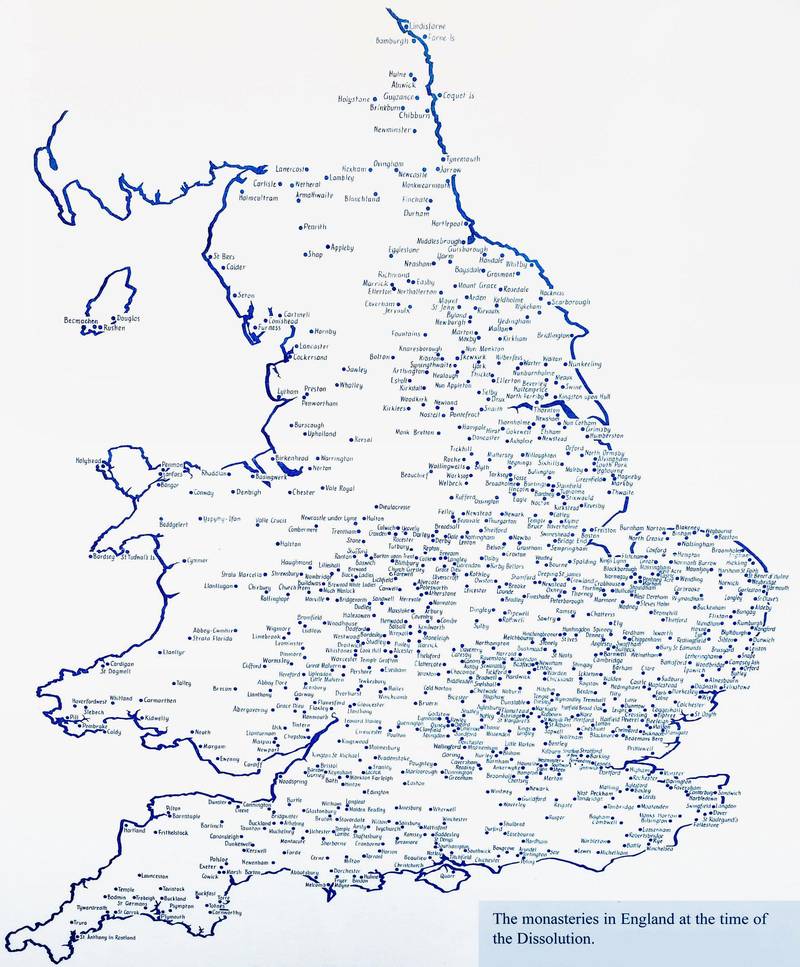
The second institutions of reference are Oxford and Cambridge Universities. These answer the question the monasteries leave open: how does rigorous, universally-recognized credentialing hold across a federation of independent local institutions? In their own microcosms, neither Oxford nor Cambridge is a single institution; each is a federation of self-governing residential colleges. The colleges hold the tutorial, the High Table, and the formational responsibility; the University holds the examination, the degree, and the professors. The college and the university are structurally distinct; each self-governing, each essential to the whole. Every college is locally governed, while the university credential is universally recognized. This architecture produced the most durable academic tradition in the English-speaking world — and it maps, at distributed scale, onto the Christian Hall and its university partners.
The difference, in America, is geographical. These colleges are not gathered in one ancient city, to serve a country the size of Mississippi. The American Halls are planted across America, in the places students already call home. And the ambition is proportionate to the country: America is seventy times the land-pass of England. This nation — federalized by design, self-governing by its Anglo-Saxon instincts, abandoned its roots to modernist educational activists. In rejecting the Factory Model of education, the Hall tutorial method demands a local presence: one tutor, a handful of students, primary texts, preparation, argument, application — the pedagogy that formed the West's leadership class for eight centuries, re-placed into the reach of a rancher's son.
A Day in the Life
What does the model feel like from the inside? Take a composite day from the network's strongest Halls, because the daily rhythm is the curriculum.
A student wakes in a household, not a university dorm — four students around a common room, or in his own family's home. University lectures and study expectations are delivered, either digitally or in-person. The student meets with a tutor, either one on one or in a small group seminar, with primary texts on the table. Accredited responsibilities and exams from the university partner run underneath the experience like rebar in concrete. Nobody disappears into anonymity, because anonymity is architecturally impossible.
The afternoon belongs to the place. Students disperse across the community to work beside practitioners in their fields of study — a petroleum engineering student to a local drilling operation, a future teacher into a classroom, a business student to an entrepreneur's back office, an agriculture student onto working land. This is not an internship program bolted onto a degree. It is the degree's other half: the city as classroom, the county as laboratory. The
evening closes the loop — a long dinner where tutors, students, and community members share tables; some nights a guest argues a question, some nights there is music, most nights there is simply the conversation that every other institution in American life has optimized away. Mentorship happens when people share life.
That rhythm — household, worship, seminar, tutorial, apprenticeship, table — is the product.
6. The Model at Work
Five years in, the model is no longer a thesis.
More than one hundred fifty Halls operate today, with three thousand students in the system and hundreds of additional Hall applications in process. Twelve accredited universities, seminaries, and colleges — Houston Christian University, Southeastern University, West Texas A&M, Indiana Wesleyan, Colorado Christian, William Jessup, Simpson University, Gordon-Conwell Theological Seminary, Grace School of Theology, Union School of Theology, Dallas International University, and Donnelly College — already support with their degree programs these local Halls. The accreditation question, in operational terms, is settling into place: real universities grant real degrees to Hall students in their own communities, every semester. The constraint is not academic legitimacy. It is how fast directors can be trained and local partnerships stood up.
What Gives a Hall Its Shape
Each Hall takes its form from three choices that must align — and the alignment is where the model's quiet genius lives.
First, the sector of local flourishing it serves. A place is whole when its spheres of common life are taught and filled by its own formed people: Faith & Worship (local pastors and ministry leaders), Wisdom & Letters (local scholars, writers, and teachers of the liberal arts), Formation of the Young (local teachers and school leaders), Self-Governance (local lawyers, public servants, and civic leaders), Local Enterprise (entrepreneurs and businessmen), Craftsmanship & Built Work (tradesmen and makers), Tended Land (farmers and ranchers), and Applied Sciences & Health (local engineers, scientists, nurses, and doctors). These sectors provide a diagnostic opportunity: run down the list for any American county and mark which spheres it still staffs from within, how many of these people came from this place, and you have measured, precisely, how far the extraction machine has gotten.
Second, the Hall blueprint — provides a clear signal for the purpose of the Hall: a Classical Honors College built on the Great Books and the tutorial; a Teacher College forming teachers for the schools of its own place; a Theological College inside an ecclesial tradition; a Community Hall — offering an affordable, formation-centered answer to the secular commuter community college; a Civic Hall for law and public life; a Business College for local enterprise; a Trade Hall on the master-apprentice pattern; a Health Sciences Hall forming nurses within Christian ethical formation.
Third, its tutor networks — CHI works to identify well trained national networks of educators from which these tutors emerge: classical educators, worldview fellows, pastor-theologians, working scientists and scholars, master craftsmen. This is why the model can scale quickly without diluting: we are rehabilitating and redeploying the elder statesmen of our communities for the training of the next generation; the Hall gives their vocation a structure for effective work.
When sector, blueprint, and network align with a real place's existential needs, the recruiting conversation is simple: you already teach classical literature to homeschoolers in your county; here is an accredited degree program, a proven institutional form, and a structure to assist you — start the Hall your place has been lacking. The discipline of the model is identifying the appropriate sectors, blueprints, and human capital necessary for success.
Economics Built for Families First
The finances are designed with a set of core convictions: a family should be able to choose this educational model without financial heroics, and a graduate should leave with no debt. Tutors should be honored for their service. Institutions that serve the network and discipline their cost structures should be sustained financially Credit hours price at $100 for high-school dual credit, $250 at the associate's level, $350 at the bachelor's, $450 at the graduate — a fraction of prevailing tuition. A student can carry a full load for less than the price of the incumbent system's textbooks and fees, working locally as he studies, and graduate without debt — embedded in place, employed, married, and home.
Revenue divides to sustain the network: half to the university that holds the degree and its academic standards, to sustain the professors and institutional structures; a quarter to the local Hall that delivers the formation — funding its tutors and its community life; a quarter to the backbone that holds the network together, with standards, stories, and structure. The network's growth is funded by the network's work, and the incentives all point the same direction: the university grows enrollment it could never reach alone, the Hall earns its sustainability by serving its students well, and the backbone's share funds the training, technology, and standards that sustain and support the whole.
This structure leans to self-governance, subsidiary, and sustainability. On the conservative projection, the network grows from two hundred Halls in 2026 to fifteen hundred by 2031. This — the co-enrolled, tutor-formed, debt-free Hall, multiplied across American places — is Christian Halls' work today. It is the proven core this paper asks you to fund; everything that follows exists to serve it.
7. The Hall as both Necessary — and Not Sufficient
There is a limit to the Hall.
Form a young man superbly — root him in Scripture and the Great Books, apprentice him to masters of his craft, surround him with a community that expects greatness of him — and then return him to a place with no work worthy of his training, no housing his young family can afford, no spouse to build a family with, no institutions to receive his energy, and no story that honors his choice to stay. What happens next is not a mystery. The extraction machine takes him, even if with tears, because a person cannot live inside a conviction. He lives inside an economy, a housing market, a set of institutions, and a story.
As we build the human capital necessary to re-place education - tutors, fellows, students, and mentors - there are other institutions that need to be replaced for the mission to succeed in the long run. We need institutions that run alongside and support this mission. Currently, we are running on mis-aligned rails:
Its pedagogical content is leased from misaligned masters. The courseware inside most accredited online programs — including, necessarily, much of what flows through our Christian university partners — is licensed from a handful of publishing conglomerates whose materials are neither values-aligned nor place-aware. The movement's intellectual bloodstream is leased from the culture it is trying to outgrow. We will need to build a publishing entity aligned with our purpose.
Its recognition is borrowed. Accreditation and state authorization come from categories built for the residential campus and the online program. The model's greatest strength — in-person community formation layered on accredited online instruction — is the very thing the rules struggle to comprehend or support, and our partners must navigate cautiously as a result.
Its physical spaces aren't built. The campuses, villages, and marketplace districts of Section 7 require development capital, land expertise, and construction management that the network's backbone nonprofit does not possesses — or should it.
Its graduates' livelihoods are unsecured. A formed and credentialed young person still needs a local economy, employers who know him, and a first job that does not require a moving truck.
We will need to build institutions capable of serving the mission — that is the work of the next part of this paper. The Hall is the heart. What follows is the rest of the body.
Part III — The Road Ahead: The Ecosystem a Flourishing Place Requires
The third movement: the larger ecosystem that rises around the Halls.
We can now pivot from what has been tested — our current moment — to the future of our national places. The Halls, the CHI Backbone organization, and Aspen Operations are launched. What follows is what comes next, for long-term cultural change.
8. Building Embodied Places
There is a dimension of formation that no curriculum reaches, and the extraction economy has taught us to forget it: places shape people just as much as programs.
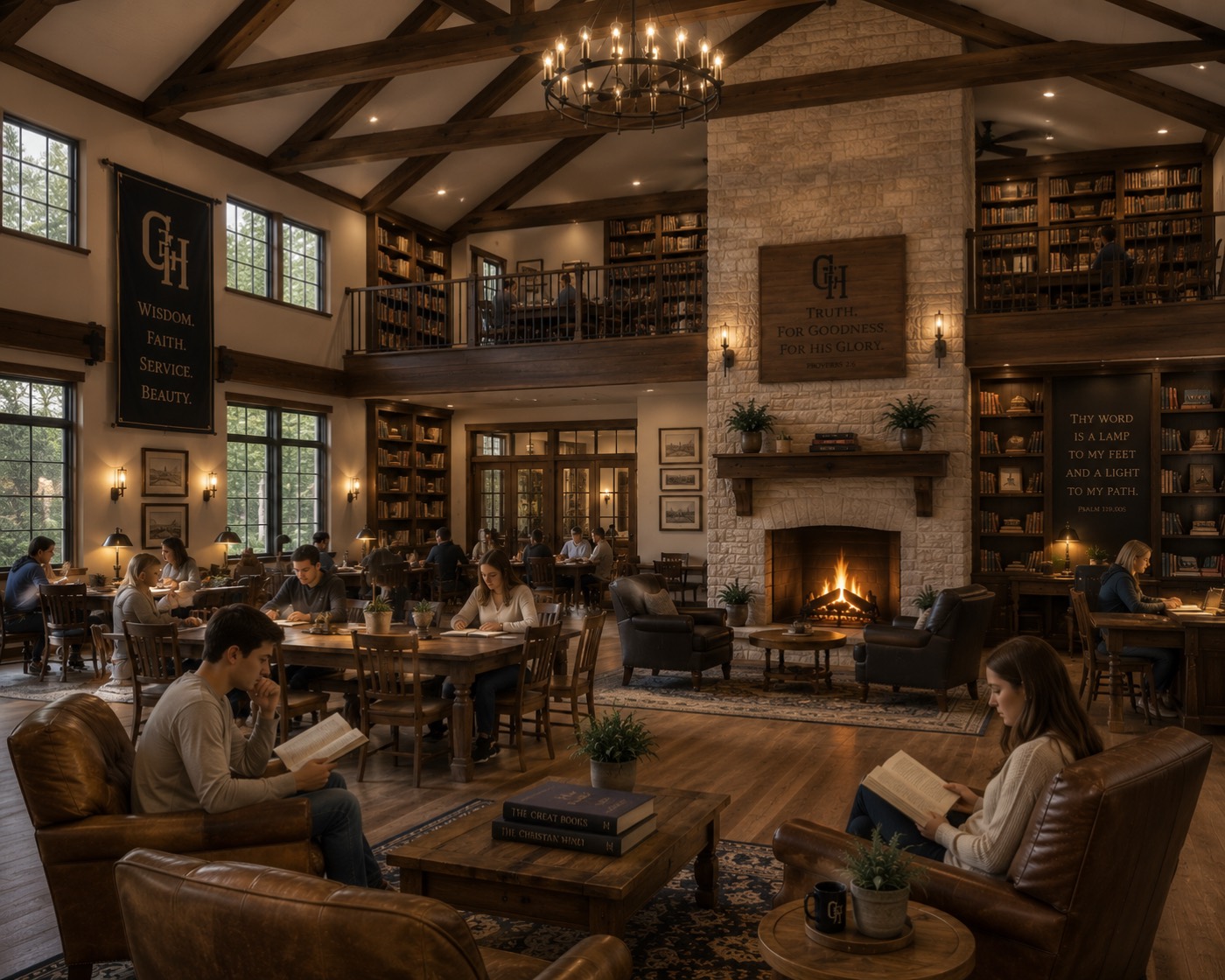
The synagogue, the forum, the abbey, the college quadrangle, even modernist soulless architecture — each is a building that teaches. The table where faculty and students eat together; the commons where an entrepreneur reviews a student's business plan; the library that inspires awe; the chapel that communicates permanence to a generation raised on the disposable; the workshop where hands educate minds. None of this is campus decoration. It is pedagogy in limestone and timber.
Most Halls begin without any such structure — they begin in a church's education wing, a school's borrowed classrooms, a co-op's rented hall, a coffee shop franchise. That asset-light beginning is a feature, not an embarrassment: these humble beginnings mean a Hall can start anywhere, and why one hundred fifty of them exist today. But the mature form of a Christian Hall learning community — the form toward which the strongest Halls grow — is a built place. What follows is what that looks like when a community builds it on purpose.
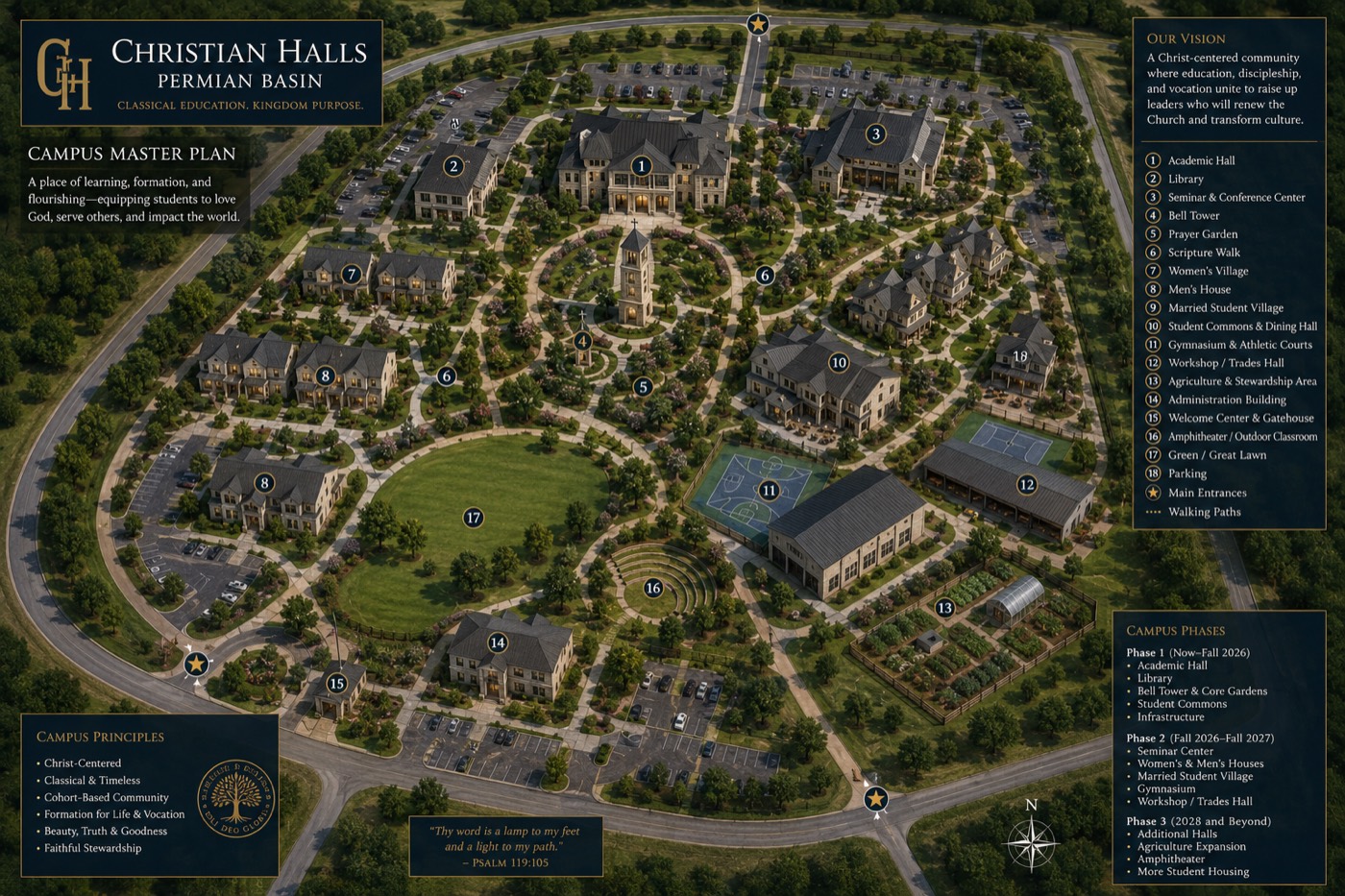
The images through this section come from the most developed prototype study to date — a concept for the Permian Basin of West Texas, drawn in the region's own architectural language: Texas limestone, handcrafted brick, heavy timber, deep porches against the western sun, materials chosen to age beautifully across a century. A Hall campus in New England speaks classical brick and white clapboard; in the Southwest, mission courtyard and shaded arcade.
The Permian study proves the visual standard: photoreal, architecturally serious, specific to a real region. Companion studies are commissioned to the same standard, each in its place's own vernacular:
A Collegium of Shared Formation
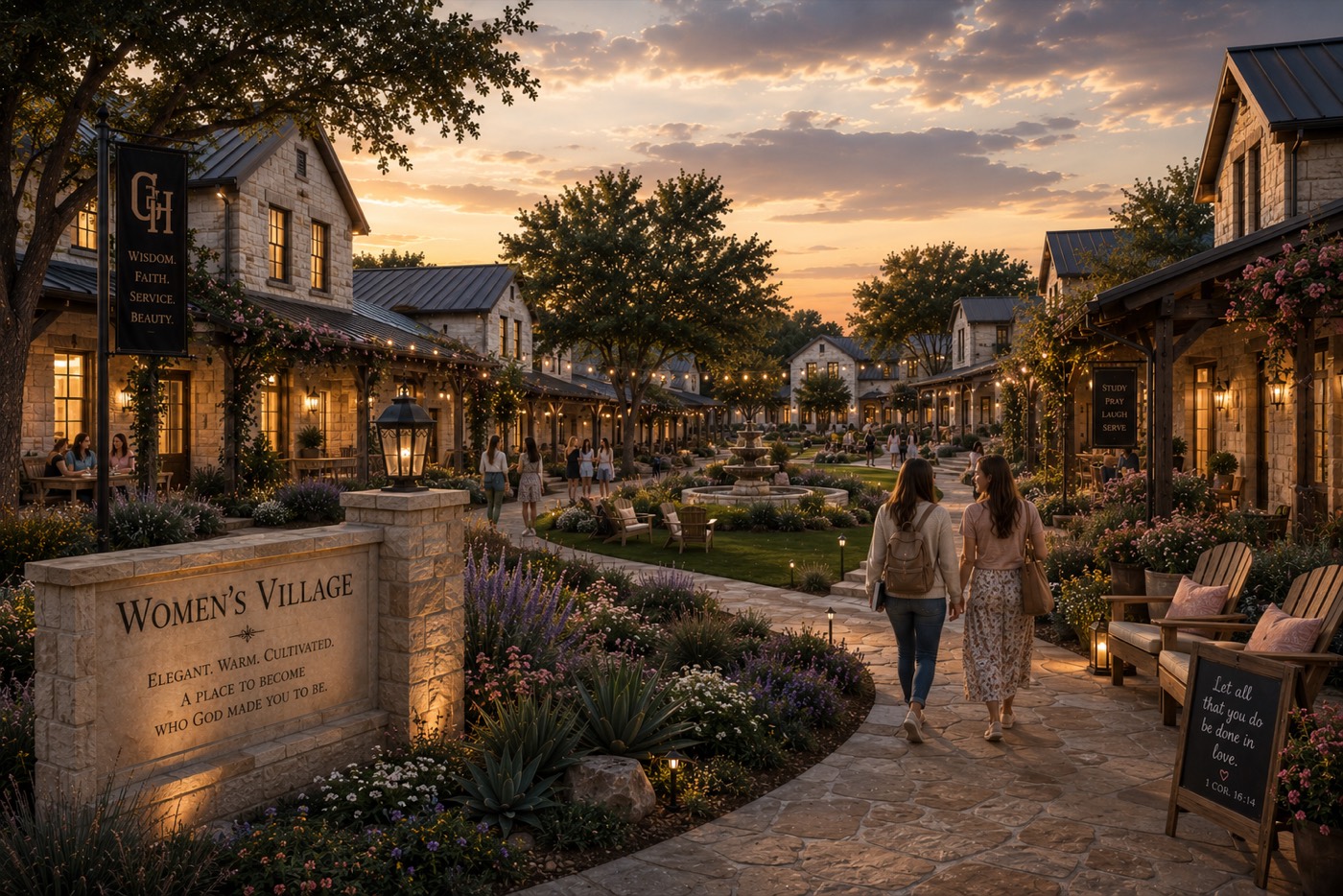
Students live in households. Four private bedrooms around a common room built with craftsmanship — solid wood, good lighting, real books, a coffee pot — where the ordinary disciplines of shared life (hospitality, responsibility, conflict resolved at the kitchen table) are learned by living. The men's and women's villages are distinct and distinctly formed — a lodge where a young man is given a sense of expected greatness, compared to a a feminine circle of beauty and welcome.
The Civic Rooms
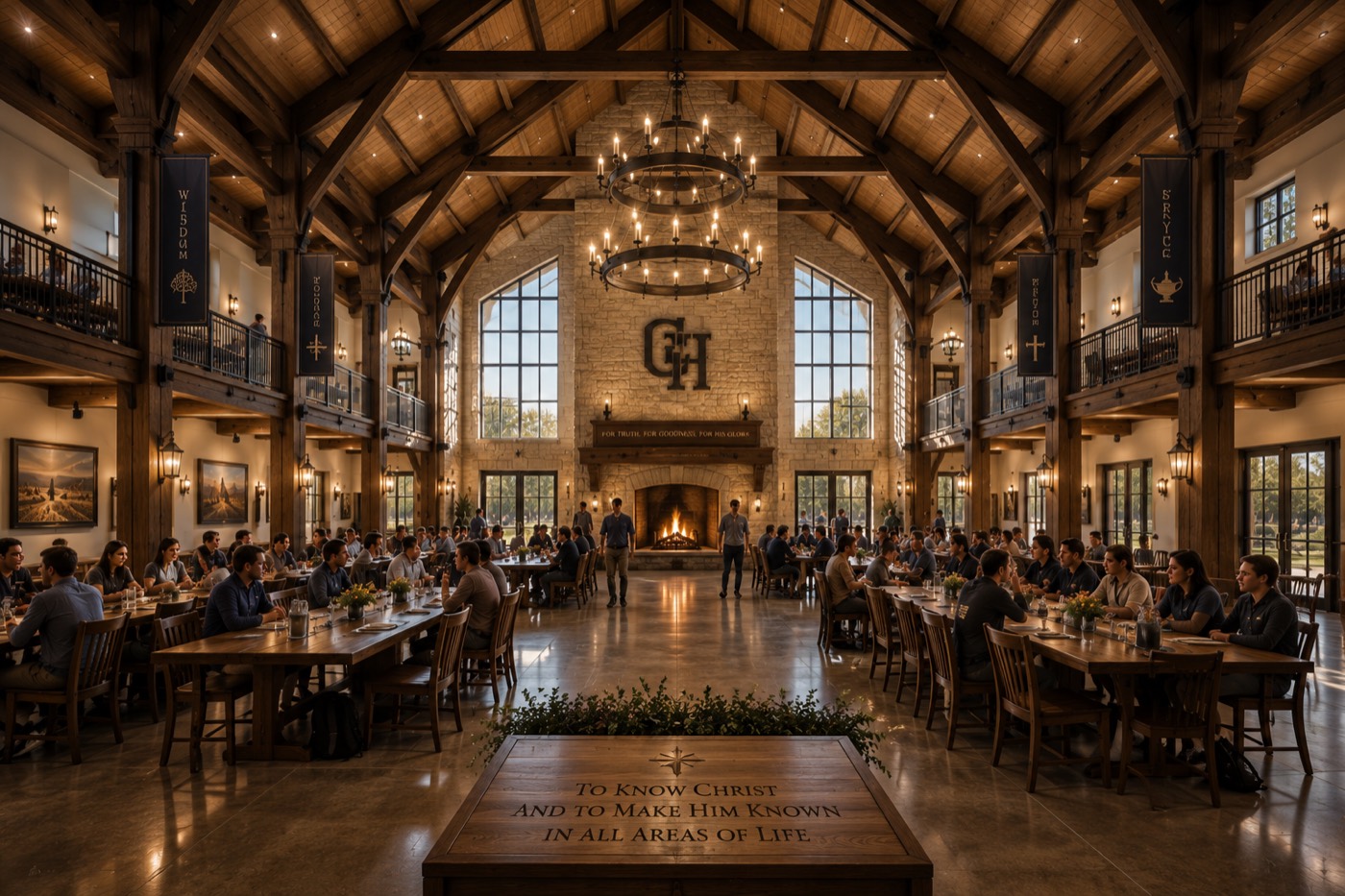
The Great Hall is the beating heart — not a dining facility but a civic room, where the community eats, celebrates, debates, and holds its High Table nights with guest speakers and music and honor shared between generations. The commons is its weekday counterpart: coffee, chess, an oil executive lunching with freshmen, a pastor mentoring an engineering student, an artist sketching in the corner — the room where the artificial walls between education, family, business, church, and civic life quietly dissolve.
The Place as Teacher
These dwelling spaces are deliberately woven into its city and place. Local businesses serve as afternoon apprenticeship sites; churches as spiritual formation partners; the whole surrounding economy as the working half of the curriculum. In the Permian prototype, a ranch property outside the city extends formation into the land itself — horsemanship, working cattle, marksmanship, barn raisings, bonfires and storytelling nights: the unhurried fellowship and physical competence that no classroom produces and no graduate forgets. And the traditions knit it together across years — opening convocation, founders' day, community feasts open to the whole town, a service week each semester. Traditions create memory; memory creates culture; culture finds expression in the story of its buildings.
9. One Mission, Many Hands
Before the institutions themselves, the architecture that holds them — because the architecture is the answer to the two questions every serious reader is already asking. How does a movement build a publishing house, an accreditor, development companies, and a capital fund without becoming a bloated conglomerate? And: how does it keep all of that pointed at the mission across fifty to one hundred and fifty years and beyond?
The answer to both is the same: nothing in this ecosystem is owned from the center, and everything in it is aligned to mission.
The organizing discipline comes from the best-documented framework in modern social-sector practice — Collective Impact, articulated at Stanford a decade and a half ago and proven since across hundreds of cross-sector efforts. Complex social change does not come from a single organization scaling itself. It comes from five conditions working together: a common agenda every participant has genuinely adopted; shared measurement, so that success is commonly understood by all; mutually reinforcing activities, each participant doing what it is best rather than duplicating its neighbors; continuous communication across the whole; and a backbone organization that serves the network without running it. The research is equally clear about the failure mode: backbones that over-build, absorb operations, drift into empire, and become the centralizing force they were founded to prevent.
Accordingly, we have structured this ecosystem as federated, deliberately and permanently:
At the center sits the backbone — Christian Halls — small by design, holding what must be held in common: the mission, the standards, the measurement of outcomes, the reference designs, and the story. It owns no Hall, no specialized operator, runs no publishing house, develops no real estate, manages no fund. It builds structure. The moment a function requires significant capital and specialized risk, that function belongs outside the backbone.
Around it stand the operators — independent, specialized, mission-aligned entities: a publishing house, an accreditor, a technology platform, real estate companies, a capital vehicle, professional placement offices, sector operators to support Halls for training in medicine and skilled trades. Each operator is separately governed, separately capitalized, and professionalized. Each exists for the mission. They are bound to this mission by two instruments:
The charter — a written standard of mission alignment, specific enough to adjudicate: what the ecosystem exists to produce, and what every certified partner entity must practice. Specificity and clarity are kindness here. A vague creed invites certain drift; a precise charter lets every party know exactly what it signed, and lets enforcement be principled rather than political.
The mark — the network's certifying brand. The mark is licensed, audited, and revocable. An operator that drifts loses its certification, its place in the network, and the network's business. That is franchise-grade accountability with no franchise ownership — enforced by covenant, not equity.
Two financial rules complete the system architecture. First: Halls, Institutions, and the backbone entity are sustained through earned and shared revenue. Second: operators share upside.** Each commercial operator's charter carries a modest royalty on its bottom line, flowing to the backbone — disclosed, audited, and capped. The operating entities that profit from the network the mission built help fund the mission. As the operators mature, those royalties progressively replace donated dollars at the center — which is why the donor ask in this paper shrinks over time by design rather than growing by appetite.
This diagram maps the vision — but it is not a single central investment, not all one entity, and certainly not all Christian Halls. Some of what follows is operating today. Some is chartered work awaiting its builder. Some is a decade out.
Each section below describes itself plainly — and each answers the following five questions: what it is, why build it, what exists today, what it becomes, and who builds it.
10. The Backbone: Keeper of the Whole
What it is. Christian Halls itself — the national nonprofit at the center of the map, performs six core functions: guides the common vision; aligns the network's activities; holds shared measurement of outcomes; builds public will and shared story; advances the policy conditions the mission requires; and mobilizes the funding that moves through the ecosystem.
In practice, the six functions have concrete names. The backbone trains and certifies Hall directors and supports the Field Guides. Field Guides are the coaching and consulting corps that walks alongside each Hall, translating the movement's intellectual work into a particular Hall's practice, and carrying each place's lived lessons back up to the whole. CHI negotiates and stewards the university partnerships every Hall depends on. It maintains the shared learning - the tested reference designs, academic, architectural, and financial, from seminar-room practice to campus master plans to the deal structure of a place-build. It keeps the standards library and certification practice that define what the CHI mark means. It supports the Senior Fellows — the movement's working intellectuals, each rooted in a Hall and a place, producing the essays, canon, and public argument that give the operational work its depth.
Why build it. Everything else in this paper is plural: many Halls, many operators, many places, many traditions. Without a disciplined center, plural becomes scattered — a thousand well-meaning local efforts with no shared standard, no common measurement, no collective voice. The backbone is the rule-keeper and a story-teller.
What exists today. A working national organization: one hundred fifty–plus Halls affiliated and served, twelve academic partnerships operating, director training running at capacity, field guides deployed across regions, the standards and measurement architecture in active development.
What it becomes. Intentionally limited in size. The backbone's staffing grows sub-linearly with the network. What deepens is its moral authority, not its headcount: a mature certification practice, a complete pattern book, longitudinal outcome measurements, and a bench of Fellows whose public arguments carry the movement's voice into the national conversation.
Who funds it. Donors — and, over time, the ecosystem itself. The backbone is philanthropically funded through its bridge and expansion years, becoming progressively self-funded by operator royalties thereafter. It is the specific subject of the first door of the ask in Part IV.
11. The Content Engine: A Publishing House
What it is. An independent, values-aligned academic publishing house, built to do for this movement what Pearson, Elsevier, and McGraw Hill do for the incumbent system: own the content layer.
Why build it. There exists in the education industry a quiet dependency almost nobody outside the industry sees. When a university runs an online or distributed program, most of what the student actually touches — the courseware, the assessments, the digital textbooks, the platform content — is licensed from a handful of publishing conglomerates. Our university partners are no exception; this is simply how the industry works. Which means the movement's daily intellectual diet is leased from suppliers whose materials are not merely unaligned with its convictions but structurally placeless — content scrubbed of locality by design, so it can be sold identically everywhere. A formation movement that rents its bloodstream from the extraction economy has a low ceiling on its integrity.
Why this is an opportunity and not merely a cost. Our vendors are already asking for help. University partners in the CHI network have told us directly, in the course of CHI distributing their academic programs, that a values-aligned courseware alternative is a critical need for the University mission, and that they are open for business to license aligned product. We have stumbled on a rare find: demand looking for an improved catalog. The market this opens is not a niche. Digital academic courseware is a multi-billion-dollar annual category dominated by incumbents whose scale is their weakness: they cannot serve conviction, and they cannot serve place, without breaking the sell-it-identically-everywhere model their economics require. A catalog designed for both — general-education core curriculum a Christian university is proud to teach, engineered to localize rather than erase place — enters a blue ocean with its first tenants already in the room.
The shape of the publisher. One house, multiple imprints.
The courseware imprint is the economic engine. Its beachhead is deliberately narrow: the dozen or so highest-enrollment general-education courses — composition, rhetoric, Western civilization, American history, college algebra, introductory sciences, economics, psychology — where the licensing dependency is deepest, the enrollment volume is largest, and the values gap is widest. Write once, license many, into a partner channel that is already standing and growing. The authorship pool is a structural advantage no startup publisher could assemble: the movement's Senior Fellows, its network of thousands of practicing tutors, and its university partners' own faculty — practitioners who teach this material to real students every week. The economics are the classic economics of intellectual property: heavy front-loaded investment in authorship and product, then a licensing annuity with near-zero marginal cost, compounding as the Hall network's own enrollment growth expands the captive channel. That is why this operator, nearly alone among mission ventures in publishing, can responsibly take mission-priced investment and offer a solid rate of return.
Within this publishing house, the prestige imprints — the Fellows' monographs, the movement's magazine, the formational curricula — ride the same editorial and production infrastructure, and are funded from the courseware imprint's surplus as a fixed, disclosed commitment. The prestige imprint will generally not make profitable return.
What exists today. The demand, in writing and in conversation, from named partners; the distribution channel, already standing; the authorship pool; the beachhead catalog strategy; and — in the movement's daily work — the editorial DNA: the canon-curation, the Fellows' writing.
Who builds it. A publisher. This is the first of this paper's standing invitations: an experienced educational-publishing leadership team — people who have built courseware businesses and know exactly where the bodies are buried in that industry — chartered under the CHI mark, capitalized by aligned investors, with the backbone organization convening the B2B university subscribers that will becomes the publishing house's founding license base. The consortium is the launch mechanism: five to eight partner institutions co-committing to license the catalog turns the publishing plan into a revenue floor before the first title ships.
12. Recognition: An Accreditor for What Actually Works
What it is. A new institutional accreditor — independent, outcomes-based, nationally recognized — built to see and certify forms of education the current categories cannot.
Why build it. American accreditation and state authorization assume two shapes of education. The first is the residential campus — governed by physical-presence rules, facilities standards, and geographic assumptions inherited from the nineteenth century. The second is the online program — governed by a separate reciprocity compact and its own rulebook, written to manage education that happens nowhere in particular. Between them runs a chasm, and the Hall model lives in it: accredited professors online, formation community intensely in person. The hybrid model is academically stronger than either category — it pairs the online program's reach with more human formation than most residential campuses now deliver — and yet this model is incoherent to either of the legacy accreditation systems.
The consequences are not theoretical. Our university partners thread the needle cautiously today between online and physical presence, and the caution has a cost: some limit the in-person engagement that is the model's whole point, for fear that too much community will trip a category never written with community in mind. Read that sentence again, because it is the extraction machine in miniature: the rules, as written, penalize human presence. A movement whose objective is normativity cannot leave the definition of normal in the hands of accreditation categories built to exclude it.
Why now. The recognition landscape is moving for the first time in a generation. Federal policy has opened toward new accreditors and outcomes-based recognition; states have begun severing professional formation from captured national gatekeepers, with Texas's turn away from mandatory ABA accreditation the loudest early case; and there is bipartisan appetite — rare enough to be strategic — for quality measures based on what graduates know, can do, and become, rather than on what shape the building is. Meanwhile the same university partners pulling for the publishing house have asked for this too: institutions caught between two accreditation regimes, wanting a third built for the century they actually operate in.
The one rule that governs it. Independence — real, structural, and permanent. An accreditor is credible exactly to the degree that no one it accredits controls it. Its governance remains at arm's length, standards published in the open, recognition sought on the merits, and a review process no participant in the network can bend. It serves the ecosystem precisely by belonging to no one, the way a court serves the town precisely by being no one's instrument.
What exists today. The need, named by partners; founding-consortium conversations; a regulatory window; and clear eyes about the path. This is potentially the longest institutional build in the ecosystem paper. Recognition of a new accreditor takes years of track record, staged review, and patient institutional politics. It is on the map because normativity makes it necessary.
Who builds it. Accreditation and higher-education-policy professionals — veterans of existing regional and national accreditors, state authorization bodies, and federal review — seconded and funded by a university consortium, with the movement as convener and first advocate.
13. The Operating Platform: Proof the Pattern Works
What it is. The technology and operations company that already runs beneath the CHI network — Aspen Operations — handles enrollment and student-information systems, academic brokerage between one hundred fifty Halls and twelve university partners, billing and revenue distribution, back-office services, customer service, and the marketing services Halls leverage when they are needed. In this ecosystem's vocabulary: Aspen Operations is the first CHI operator — and the pilot for the whole federated pattern.
Why build it. Every co-enrollment between a Hall student and a university partner is a data, billing, and service transaction that has to work every time; every new Hall stands up on systems it could never build alone; every university partner stays because the operational experience justifies the partnership. Multiply the current network by ten — the conservative trajectory — and the platform is the difference between a movement and a mess. No education nonprofit can build and run this at quality: it is a technology operations business, and it deserves to be run as one. Aspen is the Sabre travel reservation system to the online travel booking industry. Without it, interoperability grinds to a halt.
Why it matters beyond its function. Because it demonstrates, with a running entity, the principles asserted in Section 9. It is a real company doing specialized operational work the nonprofit backbone should not do. It is separately run, commercially disciplined, and mission-governed without being mission-suffocated. Its growth funds mission, sustainable. When this paper claims that a publishing house or a development company can be commercial, disciplined, investable, and structurally incapable of hijacking the mission — this is the standing evidence.
What it becomes. The network's shared operational fabric as the national map fills out. The platform layer is how a new operator stands up without rebuilding enrollment, billing, service, and data from scratch; a new university partner onboards in weeks rather than quarters. And as volume compounds, the platform becomes a steadily larger engine of the royalty-and-surplus flow that weans the backbone off donated dollars: Aspen is the flywheel's first wheel, and it is spinning.
Who builds it. It is built. Its work now is scaling with the network — and serving, for every operator in the ecosystem, as the working answer to the question has this pattern ever actually been done?
14. Home Builders: Development Companies for Beautiful Places
What it is. The real-estate arm of the ecosystem — not one company but a pattern of them: independent development and property-management entities that finance, build, and operate the physical spaces of Section 7 — the residential villages, the great halls and commons, the married-student housing, and the marketplace districts that give a Hall community its body.
Why build it. Housing is where the extraction machine does its quietest work. A young tutor called to give his life to a Hall cannot answer the call if there is nowhere near it his family can afford to live. A married student is priced out of the very community built to form him. We need specialized operators in this space, because the Hall isn't qualified, the backbone shouldn't, and the conventional developer won't build household villages and great halls when the same acreage yields more as self-storage. Formation is embodied; bodies live in buildings; whoever builds the buildings sets the terms of the community.
Why the economics work. Because this layer is real assets with real income — housing rented to a growing residential community, commercial space leased to real businesses. The marketplace district in the Permian prototype carries its purpose in its charter: support the students and families, create local jobs, and generate the revenue that funds scholarships and new Halls. This is the oldest endowment model in education — the college that owns the ground it grows on — rebuilt for the American landscape. For investors, it is the most conventionally legible layer of the entire map for a return on investment: real-estate capital, deployed for the good of communities.
What exists today. The prototype study rendered through this paper — master plan, phasing, district economics, and a complete architectural language for one region; the first candidate places, led by Christian Halls Permian Basin, where Hall density, donor strength, civic appetite, and workforce partnerships already overlap; and a forming conversation among mission-aligned builders, developers, and family offices.
Who builds it. Private investors, developers, builders, and property operators — chartered under the mark, from local capital led by local conviction. The first build is the pattern-maker, and the lessons learned will become referential for every subsequent place.
15. Mission-Priced Capital: The Fund
What it is. The financial instrument the rest of the map has been implying: a mission-priced investment fund that capitalizes the ecosystem's commercial layer — the publishing house first, the operating platform's growth, in time the sector companies — standing alongside the per-place vehicles that finance the ground.
Why it exists. Because the institutions in this part of the paper are businesses, and funding businesses with the wrong capital breaks them in one of two directions. Gift capital funds such operations poorly: donations don't discipline operations, and don't scale with success. Conventional business capital funds them dangerously: an ordinary fund's obligation is maximum extraction on the fund's clock — precisely the logic this movement exists to cure.
What mission-priced means. Plainly: capital that returns, at terms set by the mission's health rather than the market's maximum. Investors should expect their capital back, with a modest, transparently-stated return — priced so the enterprises stay disciplined and the investors stay whole, but never so aggressively that an operator must choose between its covenant and its cap table. In structure: one fund, opened in tranches as sectors mature — perhaps prioritized for content first, given the publishing house's anchor demand; then for sector companies as they are chartered; and for real estate plays as the ecosystem requires. The specifics — instruments, terms, waterfalls — belongs to counsel and the founding investors, and this paper is an invitation into that design.
Why an investor would. Three reasons. The assets are real — multi-family living spaces with secure, high-integrity tenants, and local marketplace companies with revenue.
Who builds it. An experienced fund team — the faith-driven, patient-capital discipline this requires now has a real bench of practitioners — chartered at arm's length like every operator, with founding investors who understand that they are designing an asset class, not joining one.
16. Talent and Deployment: From Formation to Livelihood
What it is. The connective institutions that carry a formed person from the Hall into the working life of a place — a professional placement network, and formation experiences (from study abroad to foreign exchange).
Why build it. The extraction machine's last and strongest argument is a job offer somewhere else. A Hall graduate — formed, credentialed, and willing to stay — still faces a labor market wired for departure. We must close this infrastructural gap.
Placement. A deliberate network connecting graduates to the businesses, schools, hospitals, churches, and civic institutions of their own regions — and connecting mission-aligned employers to the local talent pool. The demand side is already knocking: regional employers around the network's strongholds — including workforce partners in the Permian energy economy — ask us for graduates now, in numbers the network cannot yet supply. Employers everywhere have learned the cost of the transient hire; a pipeline of the locally-rooted, high-virtue graduate is a product the market wants and no one stocks.
What exists today. Informal placement through Hall directors and partner employers, with regional workforce partnerships forming around the network's strongholds.
Who builds it. Talent and workforce professionals for the placement network.
17. Allied Traditions: The Confessional Backbones
What it is. Peer governance for the movement's breadth: parallel backbone organizations through which whole Christian traditions govern their own expressions of the model — Campion Halls for Catholic communities, the Anglican University of North America serving the ACNA communion, and Wesleyan Halls for the emerging Global Methodist tradition — with the pattern expandable to every Nicene tradition.
Why build it. Because the alternative is a choice between two failures. On the one hand, a lowest-common-denominator network asks each tradition to sand off its distinctives; but deep formation happens inside traditions, not between them. On the other hand, a single-tradition network keeps its depth but forfeits the breadth the mission requires: no one tradition can serve well its local place, completely. The subsidiarity that governs everything else in this paper governs confession too. A Catholic Hall should answer to a Catholic backbone — its own doctrinal standards, its own episcopal relationships, its own sacramental and intellectual formation — not to an interdenominational committee's compromise. The same for an Anglican Hall, a Reformed Hall, a Baptist Hall. The traditions stand distinct, and they interlock: allied, not merged, the way the whole ecosystem is allied, not merged. These are the movement's parallels to the Benedictine, Cistercian, Carthusian, and Cluniac monastic orders, but within the American distinctive traditions.
How it works structurally. Each confessional backbone is a peer, not a subsidiary of CHI — it has its own boards, doctrinal standards, its own curated network of Halls, in covenant with the broader movement and served by the same shared infrastructure. Place-fidelity requires nothing less: a network claiming to serve San Antonio or Deep Ellum without the ecclesial communities of San Antonio and Deep Ellum would be serving a map, not a place.
What exists today. Confessional backbones forming — Campion (Catholic), AUNA (Anglican, in partnership with a denomination of hundreds of parishes), and Wesleyan Halls - as a pattern for the larger ecclesial communities across America.
Who builds it. The traditions themselves — bishops, denominational bodies, confessional educators — with the movement as infrastructure and ally. The pattern is theirs to take up, and the door is open for their leadership.
18. Operating in the Hard Sectors: Companies for Medicine and the Trades
What it is. The heavy end of the operator map: sector-specific operating companies for the professions whose formation requires expensive, regulated, physical infrastructure — clinical training in partnership with hospital systems for nurses and health workers; trade schools and working shops for the building crafts; structured apprenticeship pathways into law and public life.
Why build it. Look again at the sectors of local flourishing, and notice which ones the modern economy has centralized hardest: medicine and the skilled trades. A town that cannot form its own nurse sends its daughters to the city to become one, and the city keeps them; the hospital that could not form her now rents her replacement from a traveling agency at triple the wage. The pattern repeats for the electrician and the lineman, and for the family-firm attorney. These sectors require significant capital assets, within licensure regimes no volunteer effort can satisfy.
What the pattern looks like. In health: a company that partners with regional hospital systems to run clinical formation across a region's Halls — the academic degree through a university partner, the clinical hours through the system's own wings, the ethical and spiritual formation through the Hall — producing nurses formed in and for the region's own hospitals, in the middle of a national nursing shortage. In the trades: a company whose working shop partnerships anchor a region's Trade Halls on the master-apprentice pattern, graduating craftsmen with accredited credentials, real portfolios, and standing offers from the contractors who helped train them. In law: as states continue opening apprenticeship-shaped pathways to the bar, structured programs pairing accredited coursework with formation in working firms and courthouses — returning the formation of a county's attorneys to the county itself.
Why these are built later — and named now. They are the most capital-intensive and specialized entries on the map. They will be necessary, however, to deploy into these key areas that contribute to the local flourishing, and as such must be built as the competence and capital emerges.
Who builds it. Hospital systems, master tradesmen and trades educators, and the professional bodies of each field — in chartered partnership, sector by sector, as the ecosystem's earlier organs come online.
19. The Story: Narrative, Memory, and Public Will
What it is. The movement's voice — the storytelling, culture-facing work that makes the honor of place imaginable to people who have never seen it lived: the magazine and the Fellows' public writing; film and documentary work; the renderings and pattern books that let a family see the future this paper describes; the modeling for gatherings, feasts, and public traditions that give the movement a face in its places.
Why build it. Because the extraction default is not held in place by arguments — it is held by images, myths, and symbolic life. Every film about ambition is set in the city; every ranking rewards leaving; every commencement address blesses departure; two generations of American storytelling have made the one-way ticket the very grammar of coming of age. Cultures change when a new life enters the imagination — when a seventeen-year-old can see what it looks like to stay and build: the great hall at dinner, the young teacher in her own town's school, the graduate's business on the courthouse square, the married-student village with strollers on the walks. The renderings in this paper are an early instance of the standard: professional-grade, unembarrassed, specific to real places. Story is not the mission's advertising. It is the mission's air war — the public-will function of the backbone, resourced like the strategic front it is.
What it produces. the Fellows' essays, lectures, and books, carrying the intellectual case into the national conversation. The magazine — the movement's own periodical of place, formation, and the renewal of American communities. The image — films, documentaries, photography, and the architectural renderings that make the future concrete enough to fund and build. And the traditions — the feasts, convocations, commissioning ceremonies, and storytelling nights that are lived rather than broadcast, Hall by Hall, until the culture around each Hall has its own shared memory. Traditions create memory; memory creates culture; culture changes our perception of the world.
How it is built. The center must own and protect the narrative — editorial conviction, canonical language, the claims the movement is willing to make and the ones it is not yet entitled to. Production is bought: certified studios, publishers, designers, and filmmakers under the preferred-partner pattern, so the mission carries a voice without carrying a media company's overhead. In-house capacity is added only where buying is demonstrably worse — the test is efficiency, never empire.
Who funds it. Donors, as part of the backbone's core — deliberately, and in proportion to the stakes. A generational cultural re-coding is not a line item; it is a front. The mission's voice is the one instrument in this paper that should never have a customer.
Part IV — The Campaign, and the Ways to Engage
The final movement: how the whole holds together, how it unfolds, and how to walk in.
20. How It Holds Together Without Being Owned
Fifty-year institutions are not protected by the intentions of their founders. They are protected by their structure. Every reader of this paper has watched a beloved institution rot from the inside while its trustees admired the founder's portrait: the college that quietly abandoned its charter, the foundation now funding the opposite of its donor's intent, the denomination's university that kept the chapel and lost the faith. The movements that survive it are not the ones with the noblest founders; they are the ones whose discipline is structural.
The mission cannot be bought, because the mission is not for sale anywhere on the map. The backbone owns no operator, so no acquisition of an operator captures the center. The operators hold no equity in the backbone, so no cap table votes on the mission. The one instrument that binds the system — the mark — is a license, not an asset: it cannot be sold, inherited, or pledged, and it can always be withdrawn.
Mission drift must be answerable at every step and node. Certification under the charter carries obligations that are audited, not assumed: the mission covenant, the practice standards, and — for the commercial operators — open books sufficient to verify the royalty on the bottom line. A royalty on net results without an audit right is a suggestion; the charter makes it a covenant with teeth. And decertification is real, at every scale: a Hall, an operator, a developer, a vendor, an agent, or an entire affiliated institution that abandons the standard loses the mark, on a process written in advance, administered by people who did not make the original decision to certify, and applied without regard to the size of the entity or the prominence of its friends. The charter is specific so that enforcement can be principled; enforcement is principled so that it can actually be used; and it will be used. A standard that has never been enforced is a decoration.
The backbone itself is kept honest by its own smallness. The center's published disciplines — staffing that grows sub-linearly with the network, no operations that belong to operators, no capital that belongs to the fund, no land, no press, no equity — are not modesty. They are the anti-drift mechanism applied to the keeper of the mission. A backbone that cannot own anything cannot slowly become an empire; a center whose budget cannot bloat cannot breed the bureaucracy that eventually eats missions. The perimeter does what character alone never reliably does. And the same constraint answers the succession question: an organization this small, holding assets this simple — standards, measurement, a license, a story — can be governed well by ordinary faithful boards across ordinary leadership transitions. It is empires that need great men forever. We will need good men.
And beneath all of it, subsidiarity runs in both directions. Every entity in this paper exists to enable the level below it, never to absorb it: the backbone serves the operators and the Halls; the operators serve the Halls and their places; the Halls serve the families; the families serve the persons being formed. Subsidiarity at every stage. And at the bottom of the whole structure, the reason for it — a particular young person, in a particular place, becoming who he was made to become, serving those God has called him to love.
21. The Sequence: From Here to Normative
A campaign for normativity runs on two clocks at once. The operational clock counts Halls, students, revenue, and institutions stood up — quarterly, annually, auditable. The transcendent clock counts the thing the operational clock exists for — a culture re-coded, places genuinely flourishing, judged across generations, often by people who succeed us. Confusing the clocks corrupts both: enrollment numbers must never be dressed up as civilizational claims, and civilizational hope must never excuse a missed operational milestone. The campaign below runs on the operational clock, phase by phase, and each phase names its objective, its exit condition, and — because the arc is predictable — the incumbent system's posture while it happens.
Phase 1 — Operationalize (2026–2028). Convert the standing pipeline into operating Halls at scale: three hundred–plus operating Halls across the phase, directors trained to a published standard, the quality framework in force, field-guide coverage national. Alongside the network work, the ecosystem's first motions: the publishing consortium convened around the beachhead catalog; the fund's founding design chartered with its anchor investors; the accreditor's founding consortium in formation; the first place-build advanced in the Permian Basin, where Hall density, donor strength, and workforce partners already overlap. Exit condition: the network runs on standards, not heroics. The incumbent posture: it ignores.
Phase 2 — The Financial Crossing (2027–2030). Enrollment deepens per Hall; earned revenue climbs a predictable, conservative curve — and in 2029–2030 the backbone's earned revenue crosses its core operating costs. The backbone's donor dependence for core operations closes on schedule and shifts to special projects, and the first operator royalties begin arriving behind it. Exit condition: the mission no longer needs operating gifts to exist — only to accelerate. The incumbent posture: still ignoring, though its own enrollment numbers have begun to reveal our presence.
Phase 3 — Regional Saturation (2029–2033). Three to five regions reach visible saturation — enough Halls, across enough sectors, with enough institutional presence that a flourishing-place ecosystem is demonstrable rather than described. The Texas legal-education opening delivers the first sector inflection — a county's path to the bar that runs through its own courthouse and law offices. This is the phase in which the renderings in this paper become photographs. Exit condition: a skeptic can be put in a car and shown the thing working. The incumbent posture: it notices.
Phase 4 — The National Inflection (2033–2040). The designed tipping point. Halls operating across a majority of states; sector inflections multiplying — a region's teacher pipeline here, a state's apprenticeship path to the bar there, a hospital system's community-formed nursing corps somewhere no one predicted; the accreditor recognized and reviewing its first cohort of institutions; the publishing house a standing national catalog; the Fellows a fixture in the public argument. Cascades compound: a sector tips a region, a region tips a partner class, partners tip a state. Exit condition: the model is a recognized national category with its own recognition machinery. The incumbent posture: it defends.
Phases 5 through 7 — The New Norm, Permanence, and Depth (2039–2050 and beyond). The Hall becomes an expected option in an ordinary county — the way the community college became one two generations ago, but owned by its place rather than its system. Governance outlives the founders: leadership succession across multiple cycles with local autonomy intact. And the measurement the movement has been building since its first year comes due: multi-generational outcomes, longitudinally assessed, in real places. The campaign's final phases are deliberately the quietest. Normal is quiet, but transformative.
The dates above are targets under the conservative case: the moment is favorable, and where conditions allow, we intend to compress the timeline.
22. The Self-Funding Engine — and Three Doors of Opportunity
Everything in this paper resolves, financially, into one architecture with three flows.
Philanthropy funds the center. The backbone and the formation core — training, standards, measurement, field guides, the Fellows, the story — run on donated capital through the bridge and expansion years. Investment funds the operators. Mission-priced capital capitalizes the commercial layer: the publishing house, the real estate developments, in time the sector specific operating companies. It earns a financial return. Royalties close the loop. The operators' charters pay an audited royalty to the backbone — so that the center's dependence on gifts declines as the ecosystem matures.
Which brings this paper to its ask — and it is three doors. The first door is this paper's center: investment in Christian Halls itself. The other two open onto the ecosystem rising around it.
The First Door: Fund It
The philanthropic case has two tiers, in rising order of horizon.
The expansion fund — $5 million across 2026–2028. Bridges the backbone into sustainability at its 2029/2030 earned-revenue crossing: staff, training, technology, field guides, standards. This is the time-limited ask with the clear exit.
The catalytic tier — specific projects. Regional seed funds, investing in new territory ahead of the earned-revenue curve. Senior Fellows at endowed to write and teach, funding the movement's intellectual bench. Place-rooted student scholarships — a county's own fund for a county's own students, at price points where a modest gift is most of a degree. New sector launches and guided growth into places that cannot yet fund themselves. These dollars have leverage indefinitely, and each is a specific, bounded instrument rather than a general appeal.
The Second Door: Invest and Build It
If you have spent your life mastering publishing, development, capital management, accreditation, clinical education, or workforce development — we are asking you to join the mission. This part of the movement is not recruiting employees; it is convening founders and investors. Bring your expertise and your capital partners; take the charter and the mark
The Third Door: Enable It
For the public leader — the legislator, the education official, the state authorizer — the ask is neither a gift nor a company. It is public support towards a new normal. The categories that govern American education were written for two shapes — the residential campus and the online program — and they cannot see the model this paper describes; the rules, as written, penalize presence. The enabling work is concrete and largely bipartisan: outcomes-based accreditation categories; state authorization that recognizes hybrid, community-rooted education instead of penalizing physical presence; apprenticeship pathways into teaching, the trades, law, and the health professions. None of this asks for subsidy, preference, or exemption — only for rules that measure what graduates know, can do, and how they can serve in place.
Many readers may hold more than one of these doors in hand. Let's have a conversation about how to step through.
23. The Measure of Success
This movement publishes a discipline that is rare enough to state as a promise: it will claim only what it has earned. Operating Halls, enrolled students, graduated classes, revenue crossed, institutions chartered — these are countable, and they will be counted in public, conservatively, with the same numbers shown to boards and to donors. The projections in this paper are the conservative set; there is a more aggressive internal case, and it stays internal. What the movement will not do is dress the operational clock in the transcendent clock's clothes. No enrollment figure will ever be presented as civilizational renewal. Renewal is slower, and it is measured differently.
Here is how it is measured. Twenty years from now, stand in a place that took this paper seriously — Midland, Texas will do — and ask one question: are the graduates of this place's Halls building stronger families, more faithful churches, more excellent businesses, better schools, and a more beautiful town than would have existed without them? Ask the neighbors. Count the marriages and the enterprises and the school boards and the acres tended; look at who is teaching the children and who owns the shops on the square; check whether the young still leave by default or now leave only on purpose, and how many come home.
If the answer is yes — if the place itself is more truthful, more beautiful, more just, and more alive because of what was built — then the model will have done, in one place, what this paper proposes for the nation, and the communities watching will have their answer. That is the only vindication this movement is interested in. Everything else is instrumentation.
24. Questions We Expect
A paper this ambitious owes its readers a few direct answers to potential objections.
"Isn't this overreach? You run a post-secondary training network. Why are you talking about publishing houses, accreditors, and real estate?" The overreach would be attempting any of it from the center — and the architecture exists precisely to prevent that. Christian Halls will not run a press, hold land, or manage a fund; it is structurally incapable of doing so, by design. What this paper actually proposes is narrower and older than it first appears: a standards body convening specialists to build what the mission needs, the way a medieval town's guilds built a cathedral none of them could have built alone. We are seeking interoperability.
"Why not just fund more Halls and keep it simple?" Because the network has already found the walls of "simple." The content ceiling, the accreditation chasm, the housing constraint, and the placement gap are not future risks; they are current operating facts, encountered by real Halls this year. Funding more Halls without addressing these concerns only buys more exposure to the same walls.
"What if you build institutions and the mission drifts anyway?" Then the structure fights back. The CHI mark is revocable at every node. The charter is specific enough to adjudicate. The backbone cannot bloat, because it cannot own.
"Is this partisan?" No — and the design keeps it so. The claim that families are foundational, that places deserve fidelity, and that a county should be able to form its own nurses and teachers is older than every current political alignment and is affirmed, in their own vocabularies, by traditions across the spectrum — the paper cites Catholic social teaching and Tocqueville and Reformed sphere sovereignty in the same breath for a reason. The movement seeks no party's patronage and accepts no party's definition. Its regulatory work — new accreditation categories, apprenticeship pathways — is the unglamorous, largely bipartisan work of making good models good policy.
"What about the neighbors who don't share the faith?" They are among the beneficiaries on purpose. A flourishing place — its schools staffed, its enterprises locally owned, its housing humane, its civic life alive — is a common good, and the tradition this movement works from requires such. Halls serve their whole places. While the theological conviction may be particular, the blessing is general.
"Why would a serious operator accept a royalty and a revocable mark?" For the same reason a serious retailer accepts a lease in the best building on the square: the network is where the customers are. The mark comes with a standing national market — one hundred fifty Halls and growing, a university consortium, a certified-partner pipeline — that no independent could assemble alone.
"You are asking for trust across fifty years. Institutions rarely deserve it." Correct — which is why this paper asks for structure over trust. Read Section 20 again: the mission is unbuyable, the drift is answerable, the center is small by covenant, and the measures are clear. The request is not trust us. The request is hold us to this charter.
Coda: An Invitation
Every generation of Americans has built institutions at the scale of its crisis. The founders built constitutions for self-governing places. The nineteenth century built the colleges, the granges, and the parishes of a continent settling itself. The twentieth built the machinery of a superpower — and, without quite intending to, the extraction economy that superpower runs on.
The crisis of this generation is the hollowing of place. The institutional response remains to be built: the formation network, the press, the accreditor, the real estate developers, the aligned capital, the tellers of the story. Not by one organization, but by a federation of the willing and the skilled, held to an aligned standard, leveraged for a particular, human future.
That future is concrete. A nation where the county has its Hall the way it once had its courthouse and its parish. Where a family can choose, without heroism, to educate its children among its own people. Where the word ambitious has recovered its oldest meaning — the ambition to be worthy of a place, and to hand it on better than it was received.
The mission is not Christian Halls. Christian Halls is an agent — the backbone of something that must be larger than any organization, because its object is nothing less than the renewal of the American places our grandchildren will inherit. The name for what this paper proposes is a founding generation.
We are inviting you into this future.
Appendix: The Ecosystem at a Glance
Each entry: what it is · status · who builds it · how it is funded.
The Backbone — Christian Halls. The national nonprofit at the center: mission, standards, certification and the mark, shared measurement, the pattern book, director training and field guides, the Senior Fellows, and the story. Deliberately small forever; owns and operates none of the entities below. · Operating today. · Built. · Donor-funded through the 2029 crossing; progressively funded by operator royalties thereafter.
The Hall Network. One hundred fifty–plus locally-governed Halls; three thousand students; co-enrollment through twelve accredited university partners; $100–$450 per credit hour; revenue split 50% university / 25% Hall / 25% backbone; Halls never pay to belong. · Operating and scaling; conservative path to 1,500 Halls by 2031. · Local founders, cultivated and trained by the backbone. · Self-funding through earned revenue; scholarships widen the door.
The Publishing House. One house, multiple imprints: values-aligned, place-deployable academic courseware licensed to partner universities (the economic engine — displacing incumbent conglomerate licenses at partners' own request), plus prestige imprints (Fellows' monographs, the magazine, canon editions) funded from courseware surplus as a capped, disclosed commitment. · Chartered work awaiting its builder; anchor demand named — Southeastern, Houston Christian, and William Jessup among confirmed partners, with additional universities in active conversation. · An experienced educational-publishing team, chartered under the mark; the backbone convenes the founding license consortium. · Mission-priced investment via the fund; returns through licensing.
The Accreditor. A new, independent, outcomes-based institutional accreditor bridging the campus/online chasm — recognizing hybrid, community-rooted, and apprenticeship-shaped education by what graduates know, can do, and become. Carries no mark and pays no royalty, by design: its value is its independence. · Founding-consortium conversations; the longest build on the map. · Accreditation and policy professionals, convened by a university consortium; the movement as advocate, never owner. · Consortium-funded.
The Operating Platform — Aspen Operations. The technology and operations company already running beneath the network — enrollment, academic brokerage, billing and revenue distribution, service, optional marketing services. Capped margin; surplus above the cap flows to the mission by charter. The proof-of-pattern for every operator that follows. · Operating today. · Built; scaling with the network. · Commercially self-funding; growth capital via the fund as volume compounds.
Development Companies. Independent per-place development and property entities — one company per place, local costs, local builders, local capital — building the residential villages, great halls, commons, and marketplace districts from the backbone's pattern book, in each region's own architectural vernacular. Campuses designed to endow the mission that built them. · Prototype study complete (Permian Basin); first build in preparation. · Regional developers, builders, and property operators, certified under the mark. · Per-place vehicles: mission-priced local real-estate capital.
The Fund. Mission-priced investment capital for the ecosystem's commercial layer, opened in sleeves as sectors mature — content first. Capital returns at honest, modest terms; mission covenant senior to return; never invests in the backbone itself. · Founding design stage. · An experienced patient-capital team with founding investors, chartered at arm's length. · Investor-capitalized.
Talent & Deployment. The placement network connecting graduates to their own regions' employers (who are already asking); place-rooted scholarship instruments run largely through existing Christian scholarship institutions; formation journeys that send students out briefly to root them more deeply. · Informal placement operating; partnerships forming. · Workforce professionals and existing scholarship institutions, chartered and light. · Employer-side fees and philanthropy, respectively.
Confessional Backbones. Peer governance bodies through which whole traditions run their own expressions of the model — Campion Halls (Catholic), the Anglican University of North America (serving the ACNA), and Wesleyan Halls, with the pattern open to every Nicene tradition — Reformed, Baptist, Orthodox, Lutheran, Black-church, and Hispanic Catholic peers among them — as its communities take it up. Affiliation stacks; nothing is owned. · Forming. · The traditions themselves — bishops, denominations, confessional educators. · Tradition-funded, serving shared infrastructure.
Sector Operating Companies. Asset-heavy operators for the professions whose formation requires wings, shops, and land: clinical training with hospital systems; master-apprentice trade schools; teaching farms; apprenticeship pathways to the bar as states open them. · Later-phase by design; first threads visible in regional workforce partnerships. · Hospital systems, master tradesmen, agricultural operators, professional bodies — in chartered partnership. · Sector partners and the fund.
The Story. The movement's voice — Fellows' public argument, the magazine, film and image, the pattern-book renderings, and the lived traditions — kept inside the backbone (the one deliberate exception), with production bought from certified studios and craftsmen. · Active; resourced as a strategic front as the campaign scales. · The backbone, with preferred production partners. · Donor-funded as part of the core.
Dr. Nicholas Ellis · nick@christianhalls.org · christianhalls.org
Christian Halls · July 2026 · For Stakeholder Distribution